
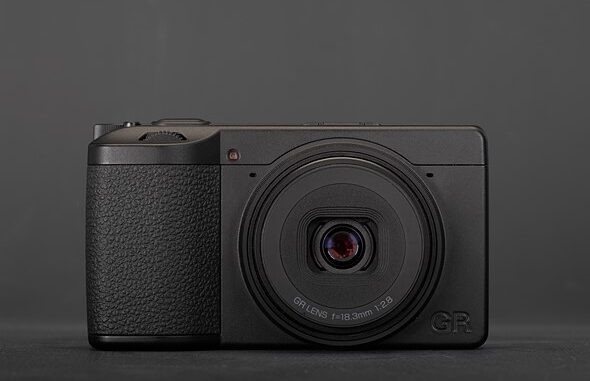
Product photos: Richard Butler
Ricoh has released a monochrome version of its GR IV enthusiast compact camera. The GR IV Monochrome features the same 26MP BSI CMOS sensor and 28mm equiv F2.8 lens as the color version, but is black-and-white only.
Key specifications
- 26MP BSI CMOS sensor with no color filter array
- On-sensor phase detection
- ISO 160-409,600
- In-lens shutter allows flash sync to 1/4000th sec
- E-shutter allows use of F2.8 at up to 1/16,000 sec
- Built-in red filter, giving punchier blues.
- 53GB of internal memory
- 250 shot-per-charge battery rating
- UHS-I Micro SD memory card slot
The GR IV Monochrome will sell for a recommended price of $2199. This is a 46% premium over the list price of the standard GR IV, suggesting Ricoh feels that the mono version will have a smaller audience to foot the development costs. The MSRP in the UK is £1599, which is only a 33% mark-up over the standard version’s original list price.
Index
What is it?
 |
As the name implies, the Ricoh GR IV Monochrome is a black-and-white only variant of the GR IV.
You get all the usual benefits and costs of a mono-only sensor: a higher base ISO, because less light is being lost to a color filter array (a 2/3 of a stop increase, in this instance), and much sharper detail, as there’s no demosaicing taking place.
You also get better noise performance at any given ISO: again because there’s no color filter sapping any light, but with that advantage disappearing if the color version can use its lower base ISO.
However, with only a single color channel, there’s a lot less flexibility to the Raw files: once the image appears to be clipped, there’s no way to approximate highlight data from unclipped channels.
The electronic shutter can deliver exposures down as low as 1/16,000 sec, letting you use the maximum aperture even in good light
To prevent overexposure when shooting at F2.8, the GR IV Monochrome lets you switch from its in-lens shutter to an e-shutter. The electronic shutter can deliver exposures down as low as 1/16,000 sec, letting you use the maximum aperture, even in good light, despite the camera not having an built-in ND filter. As with the regular GR IV, the mechanical shutter has an upper limit of 1/2500 sec at F2.8: you need to stop down to F5.6 to achieve the 1/4000 sec maximum.
Interestingly, Ricoh says the GR IV Monochrome’s autofocus is the same as that on the GR IV, which means it has on-sensor phase detection. This would mean that, unlike the Leica Q3 Monochrom, it has to do some degree of interpolation during processing, to hide any impact of those phase-detection pixels. We’ve not seen any negative impact from this in our preliminary shooting, even when trying to induce flare to highlight any issues.
The company also says that the sensor is not the same one used in the K-3 III, though it wasn’t specific about how the two differ.
Red Filter
 |
Other than the lack of color filter array, the other difference is that the GR IV Monochrome has a slot-in red filter, rather than the neutral density filter in the color version. This selectively lowers the impact of blue and green light on the sensor, which gives more dramatic skies and higher contrast, generally.
The filter in the GR IV Monochrome reduces the overall light to the camera by around 3 stops, for a neutral subject (it’s around a 4 stop cut for blues, 3.5 for greens and closer to a single stop for reds).
Body and handling
 |
As you might expect, the GR IV Monochrome looks and handles exactly like the regular GR IV: it’s a tiny camera for one with such a big sensor and yet it manages to put a lot of control at your fingertips without seeming too cramped.
The finish of the camera is also a little different, with a less textured matte black finish. The shutter button is also black and the GR logo on the front is a very dark grey, rather than white. The green LED ring around the power button is also white, to keep with the monochrome theme. Sadly, Ricoh has not borrowed the beautiful ‘Monochrome’ typography from its Pentax K-3 III Monochrome DSLR.
 |
The control logic is well worked through, as you’d expect for the eighth generation of a design (prior to 2013’s GR, with its APS-C sensor, were four iterations of GR Digital, which used a much smaller Type 1/1.7 sensor in a very similar body).
Despite its size, the GR IV’s magnesium alloy body makes it feel very solid, without being overly weighty. And, unlike almost all modern cameras, it will sensibly fit in a pocket.
Ricoh says the GR IV’s lens was specifically designed to reduce the risk of dust ingress, but that they had to make the choice between the small form factor that a retractable lens makes possible and complete weather sealing, so there are no promises around the level of sealing.
Initial impressions
 |
Ricoh was kind enough to lend us a pre-production GR IV Monochrome, to let us get a feel for the handling, but we were asked not to make measurements or publish images from it, as it’s not necessarily representative of final production performance.
But, even in the limited time we’ve spent with the camera, its appeal shines through: it forces on you that same way of looking at light and shade that Leica’s monochrome cameras bring. And I maintain that using a camera that can only capture black and white is a completely different experience to using a normal camera in mono mode. Knowing that you can’t switch, no matter how appealing the colors are in your scene means you solely focus on light, shadow and contrast.
The inclusion of a built-in, switchable red filter is a brilliant idea, letting you add that punch to your images at the touch of a button, without having to add a filter ring adapter or carry filters round with you. I’m sure there’ll be people who would have preferred a different color, but red seems like a sensible option since they had to choose one. And the option to engage electronic shutter, so that you can still shoot wide-open in bright conditions feels like a reasonable work-around.
 |
Even more so than the standard GR IV, the Monochrome version is going to be a niche proposition. Some people will immediately know they want one, while I suspect a great many people will be baffled at the idea that a regular GR IV in mono mode wouldn’t be similar enough. And cheaper.
The price of adopting a decidedly niche camera is that there are fewer people to share the development costs with. The Ricoh is just over a quarter of the price of the other dedicated mono compact on the market – though the Leica Q3 mono has a sensor more than twice the size and a maximum aperture that’s over a stop brighter, so can capture more than four times as much light – but there’s still something inherently counter-intuitive about having to spend more, for less.