

The Sony DSC-RX10 V comes a whole nine years after the Mark IV. Can the latest technology possibly justify its 2026 price-tag?
Product photos: Richard Butler
The Sony RX10 V is an update to the company’s long-zoom large-sensor compact. It’s built around a 20MP stacked Type 1 (116mm2) sensor and a 24-600mm equiv, F2.8-4.0 stabilized zoom.
It’s a long-zoom ‘compact’ whose newfound processing power means it can shoot a range of subjects from landscapes to wildlife and maybe even a little sport. We’d be tempted to make the comparison to a Swiss Army knife, only the RX10 is far from pocketable.
Key specifications
- 20MP Type-1 (116mm2) stacked CMOS sensor
- 24-600mm equiv. F2.4-4.0 lens
- Up to 30fps shooting
- 4K up to 120p with crop (60p full width) in 10-bit
- 3.68M dot EVF
- 1.62M dot tilting rear LCD
- UHS-II SD card slot
- 630 shot/charge battery life rating
The RX10 V will be available in early August with a recommended price of $2,300. This is exactly in line with the US consumer price index inflation rate applied to the $1700 launch price of the RX10 IV, nine years ago. To use a different benchmark, it’s cheaper, relative to the a7 V and that camera’s peers, than the Mark IV was, relative to its contemporary a7 model.
Index
Loading gallery…
What’s new
It’s been eight years since the RX10 IV and Sony has made big steps forward in both technology and ergonomics in the meantime: the RX10 V benefits from both.
On the technology side, the RX10 V gains the Bionz XR processor and “AI processing unit” from the previous generation of Alpha cameras. This brings the full range of subject recognition modes, including birds, animals, cars, planes and the “human pose estimation” system that is designed to recognise people-shaped things in the scene, even when the face or eyes aren’t visible, to help the camera continue to track the same subject.
The added processing power allows the RX10 V to shoot at up to 30 frames per second with a blackout free viewfinder. You also gain the Speed boost function that lets you temporarily engage a faster (or slower) shooting mode, when you hold a customized button down, but you don’t gain the pre-capture function.
Autofocus has come a long way in the nine years since the previous RX10 was released, and the new model feels like a thoroughly modern camera. The other area of significant improvement over the same period is video, and the RX10 V is a bit step forward in that regard, too, with a host of Sony’s latest options including, significantly, the ability to capture 10-bit and H.265 footage, both of which make it more pleasant to work with.
Sony says it’s the same lens as on the RX10 IV, despite different reported focal lengths
Sony says it’s the same lens as on the RX10 IV but CIPA standards for reporting focal length have apparently changed in the meantime, meaning it’s quoted as a 9.1-210mm zoom, rather than the 8.8-220mm figures printed on the side of the previous two models. We suspect the figures now quoted are the literal focal lengths, rather than the effective focal lengths after corrections has been applied. The end result is the same, though: a 24-600mm equiv range with an F2.4-4.0 maximum aperture and in-lens stabilization.
It’s hard to get your head round just how much flexibility a 24-600mm lens gives you until you use it. There are cameras that offer even more range, but all of them are based on much smaller sensors, so you pay a price in terms of image quality, if any survives the heat haze.
The lens has a built-in shutter which can go as fast as 1/1000th of a second at wide apertures, and 1/2000 sec at F8 and slower. This is great for flash, as you can sync up to those maximum speeds but quickly becomes limiting in bright light. You can switch the camera to e-shutter mode which, with a rolling shutter rate of 15.7ms (1/64sec) is still pretty fast, but this requires you to switch to the lossy compressed Raw format. There’s no auto mode to let you use mechanical shutter up to its limit, then e-shutter beyond that.
Body and handling
The RX10 V is a substantial camera but that’s to be expected for something trying to deliver a 24-600mm equivalent zoom range. It’s been a long time since we handled an RX10 IV but the grip shape seems improved, offering a sturdy grip on the dense, polycarbonate body.
There’s no front dial, the logic presumably being that you’ll use your index finger for operating the zoom rocker. This means the two command dials on the rear shoulder are both operated with your thumb. There’s also a rather fiddly dial on the rear plate of the camera but thankfully, with the provision of two customizable command dials and an aperture ring, there’s rarely need to use it (it’s not used in photo mode, by default).
Unlike recent Sony cameras, the RX10 V has a 10Gbps USB-C socket for fast data transfer but then retains the USB Micro B ‘Multi’ socket for attaching external accessories. This can no longer be used for charging the camera, reducing its usefulness to being an accessory port.
The RX10 V still uses a single SD card but the interface now uses the slightly newer UHS-II standard, rather than the UHS-I slot on the previous model. This is quick enough to accommodate the 600Mbps (75MB/s) data rate required for 4K/60 video capture with All-I compression.
Viewfinder
The viewfinde gets an upgrade to 3.68M dots (1280 x 960px), which is a decent step up from its predecessor. The resolution drops a little if you engage the high refresh rate mode, and battery life drops, too, but whichever mode you choose, the resolution is maintained, even when using C-AF, so you don’t get the potentially distracting drop in detail when you half-press the shutter.
Screen
The screen is also refreshed, with the Mark V using a 1.62M dot (900 x 600px) screen that matches the sensor’s aspect ratio, rather than the 4:3, 800 x 600px panel on the previous model. The screen is still mounted on a tilt up/down cradle, which gives a decent level of flexibility but isn’t well suited to portrait orientation shooting.
Battery
Other than the improved autofocus, perhaps the biggest change on the Mark V is the move to the much larger NP-FZ100 battery. This is the 16.4Wh battery that has powered the various a7 models for the past nine years. It has a capacity more than twice that of the FW50 battery used in previous RX10 cameras, giving much better battery life in a way that seems appropriate for a camera so likely to be used for travel and long shoots outdoors.
In use
When you first start up the camera, you’re confronted with a very simple, compact-camera display, with five large touchscreen buttons arrayed down both sides of the screen. This ends up feeling somewhat nostalgic, having not encountered a mainstream point-and-shoot for some time, and rather at odds with the more Alpha-styled controls and main menu.
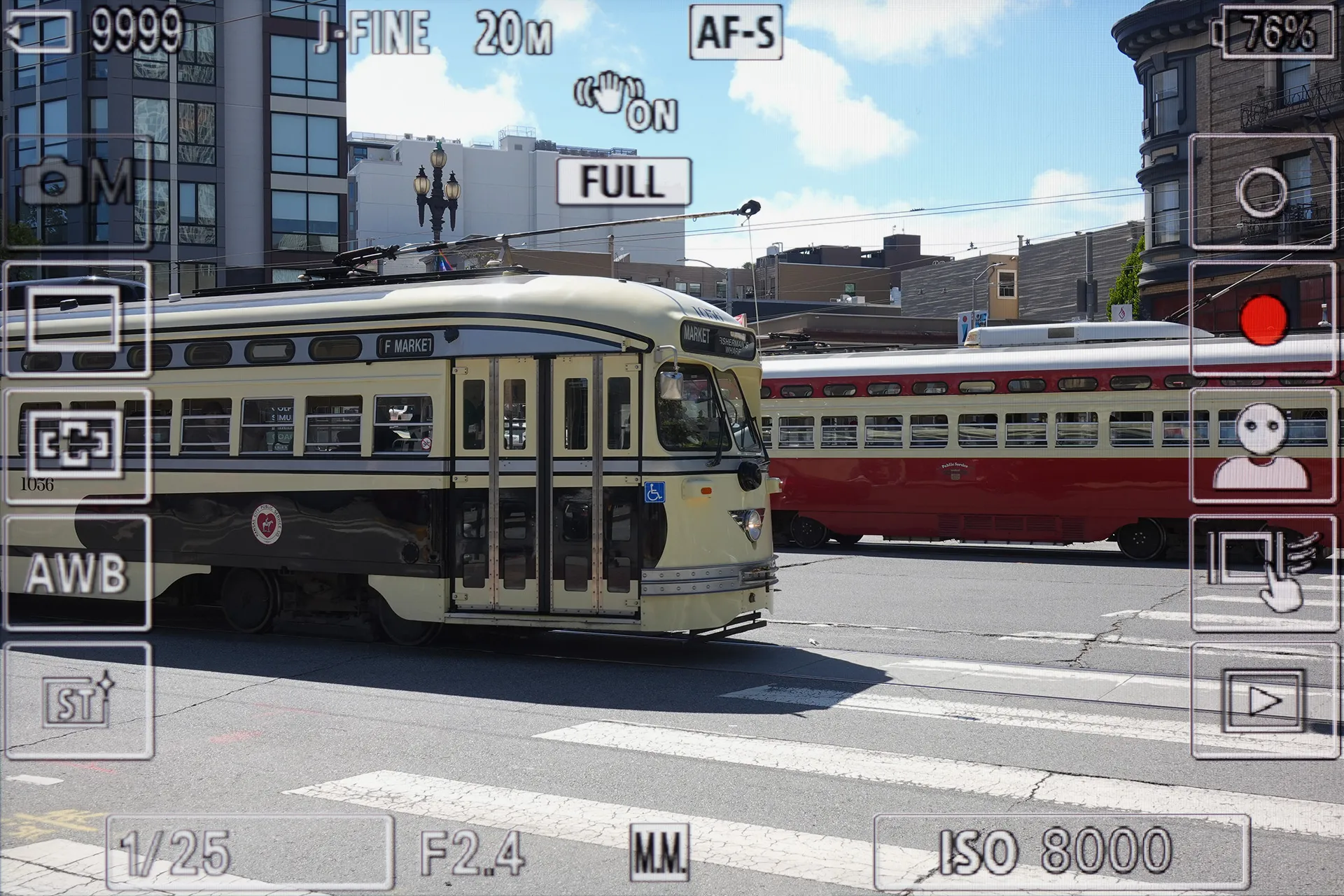
Anyone not wanting to use touchscreen buttons, or wanting a less cluttered display can remove them (the option to do so is under Touch Operation / Touch Panel Settings, rather than with the display options in Operation Customize).
With this done, the RX10 V feels a lot like an Alpha-series camera, with the new menus representing a big improvement over the ones in the previous models. It’s not without its foibles but for the most part it’s well grouped and organized, and with a little customization of the Fn menu and custom buttons, you can minimize your need to visit it.
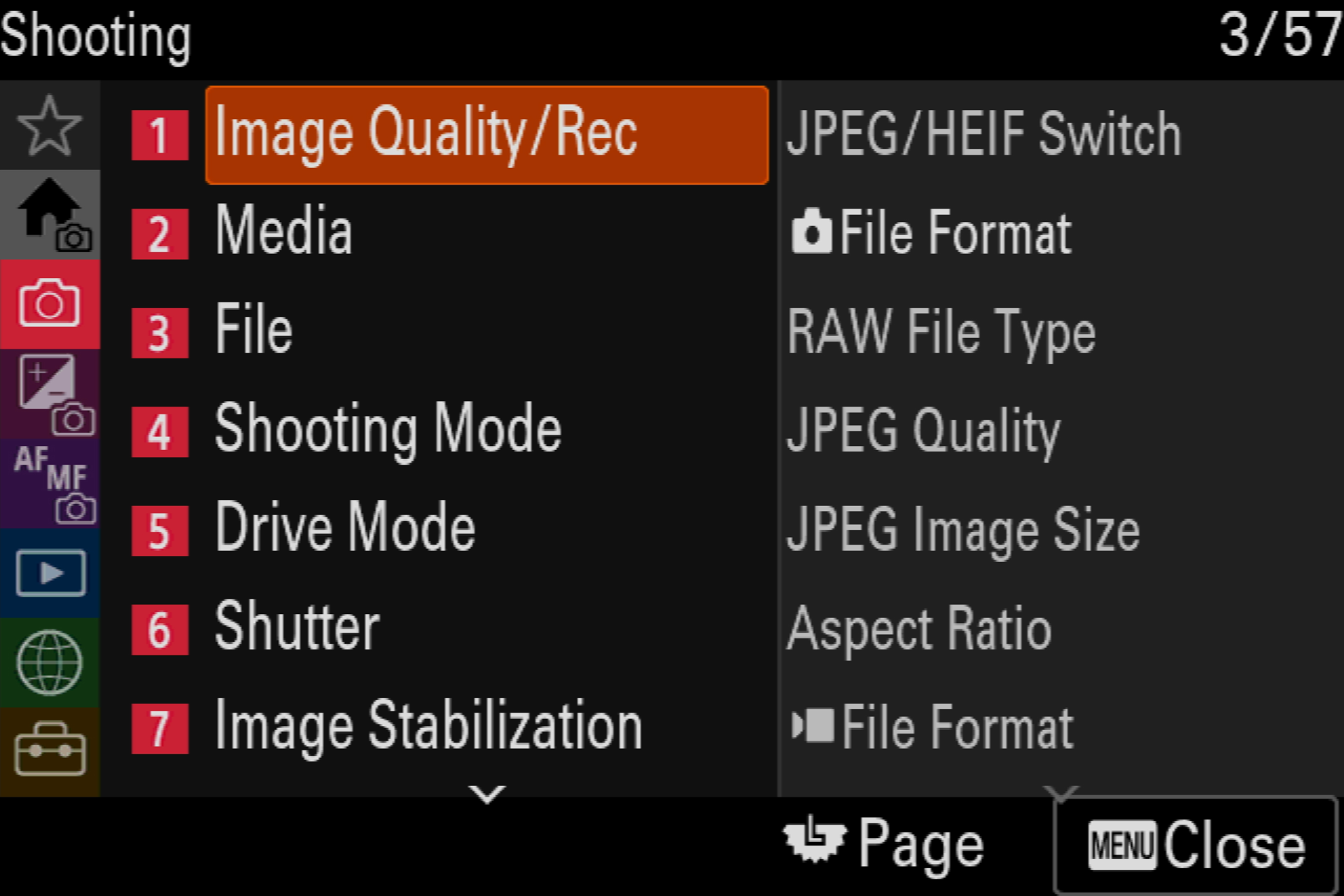
The RX10 V has the same issue as other Sony cameras in terms of a couple of incompatible settings: you’ll need to disengage Raw and switch to HEIF format before you can engage the camera’s HLG Stills mode to shoot true HDR images, and you’ll have to switch your Raw format if you want to engage the electronic shutter mode. All of which leaves the risk that you forget to switch back.
Also, somewhat disappointingly for such a travel-friendly camera, Sony remains the only major brand not to offer some kind of in-camera Raw conversion. So if you take a nice shot but want to tweak the white balance, color mode or DRO level before sharing it, tough luck, you’ll just have to messily hack the JPEG around on your phone.
There’s a lot to like, though. The dials and joystick give a good sense of direct control, letting you feel you have direct command over the camera’s really rather impressive capabilities. It has its limits, though: it will try to keep focusing if you zoom with the ring around the lens (you can’t use the zoom rocker), but it definitely struggles, which can limit some sports or action shooting. But the ability to quicky zoom with the rocker under your index finger and fine-tune the framing with the lens ring helps keep the power zoom feeling pretty engaging.
Video
The previous RX10 V’s video topped-out at 4K/30, despite the use of a fast, stacked CMOS sensor. The Mark V pushes way beyond this, with the option to shoot 4K/120 with a significant 1.38x crop or oversampled 4K/60 from the full width of the sensor. As you’d expect from a modern camera, this can all be done in 10-bit, making Log, and in particular, the more ambitious S-Log3 curve, much more usable.
But video improvements over the past nearly decade go further than speed. The RX10 V lets you shoot in the attractive, S-Cinetone color mode and it lets you upload LUTs for previewing your preferred color grade, or to burn directly into the footage. It has Sony’s Auto Framing mode that identifies a subject, punches in and follows them around, upscaling the footage and giving a camera operator dynamism to what are actually locked-off shots. There’s also the Active Mode IS that corrects a wider range of movement, available at up to 4K/60.
Then, on the audio side of things, the RX10 V can capture up to four-channel audio, if you attach an accessory to its multi-interface connectors in the hotshoe. A 72mm filter thread allows you to attach ND filters as needed.
Above all of this, though, the RX10 V’s video also benefits from its improved autofocus system, which is much more tenacious and dependable in terms of subject tracking, especially if your subject is of a type the camera has been trained to recognize.
Initial impressions

Sony RX10 V | 435mm equiv. | F4.0 | 1/1000 sec | ISO 100
It’s been nine years since the last RX10 model was released and, although things have been pretty quiet on the compact front, the rest of camera technology and performance have continued to make advances. Much like watching a young relative you rarely get to see grow up through a series of infrequent visits, the prolonged gap really makes you notice how much has changed in the meantime.
The RX10 V is a dramatically more advanced camera than its predecessor: faster to focus and much more dependable at subject tracking. The menus and ergonomics have come a long way, too, and its video capabilities are leagues ahead of where the RX10 IV had brought us to.
I’m not generally a fan of long-zoom cameras, as I’d usually prioritize compactness over that additional reach that I rarely find myself wanting to use. But the enhanced AF performance and speed capture add a lot to what was already a camera with a strong following. They vastly expand what the RX10 V can do, and the changes to the controls and battery are significant benefits, too.
Unlike the recent L10, that doubling of battery capacity hasn’t led to much of a change in body size, and it wouldn’t have made much difference anyway, on a body so dominated by that vast lens.
It’s striking to get to see what nearly a decade’s worth of improvements, delivered all in one go, look like.
There can be a few delays, here and there, waiting for the lens to initialize, and it was disappointing to have to swap shutter modes (and Raw filetype) or stop down when hitting the 1/1000 sec limit of the mechanical shutter. But overall I’ve found the RX10 V to be a pleasant travel companion whose lens constantly challenged me to think of photos that I couldn’t otherwise take.
Whether that makes it worth $2300 is for each individual to decide, but it’s striking to get to see what nearly a decade’s worth of improvements, delivered all in one go, look like.
Sample gallery
Please do not reproduce any of these images on a website or any newsletter/magazine without prior permission (see our copyright page ). We make the originals available for private users to download to their own machines for personal examination or printing (in conjunction with this review); we do so in good faith, so please don’t abuse it.
Loading gallery…
Sony DSC-RX10 V specifications
Quick Specs
- Body Type
- SLR-like (bridge)
- Effective pixels
- 20.0 megapixels
- Sensor type
- Stacked CMOS
- Lens Mount
- None
- LCD
- Tilting
- LCD size
- 3.0″
- LCD dots
- 1620000 px
- Shortest exposure time
- 1/2000 sec
- USB – Port 1
- USB 3.2 Gen 2 (10 Gbit/sec)
- Weight
- 1111 g
- Max resolution width
- 5472 px
- Max resolution height
- 3648 pixels
- Aspect ratio
- 1:1, 4:3, 3:2, 16:9
- File format – still (structured)
- JPEG, HEIF, RAW
- SensorSizeHeight
- 8.8
Press release:
Sony Electronics Introduces RX10 V
– The Fifth Generation of the All-in-One Super Zoom Camera for Travel, Wildlife, and Sports Photography
AI-powered Real-time Recognition AF and High-speed Performance with a 24-600mm*1 Zoom.
San Diego — July 9, 2026 — Sony Electronics announces the RX10 V, the fifth generation of its RX10 all-in-one camera series. A single body covers wide-angle to super-telephoto through a large-aperture ZEISS® Vario-Sonnar T* 24-600mm*1 (25x optical zoom) F2.4-4.0 lens.
The RX10 V keeps the series’ resolution, super-telephoto reach, and integrated lens design, and adds AI-powered Real-time Recognition AF (auto focus) for accurate subject identification. Paired with blackout-free continuous shooting at up to 30 fps2 (frames per second) with full 60 fps/sec. AF/AE (auto exposure) tracking, it holds focus on fast, unpredictable subjects. A 20.1 megapixels (approximately effective) 1.0-type stacked Exmor RS™ CMOS sensor and BIONZ XR™ processing engine drive both stills and up to 4K 120p3 video, covering a wide variety of scenarios spanning from everyday moments to wildlife to school sports. The large aperture and 1.0-type sensor render soft, natural background blur.
The RX10 V borrows its button layout and grip design from the α™ (Alpha™) mirrorless series for intuitive control. A larger4 Quad-VGA OLED electronic viewfinder shows fine detail clearly in bright sun or indoors, helping you compose precisely. The Z-series NP-FZ100 battery extends still shooting to approximately 630 shots5, roughly 50% more than the previous model*4.
“The RX10 series camera became a cult classic because it is a joy to shoot with in real life scenarios, and its range is unparalleled in a compact camera body. With the camera’s fifth generation we are bringing valuable features from our Alpha line to make the RX10 V an unbeatable choice for any passionate wildlife, birding, or sports photographer,” said Yang Cheng, Vice President of Imaging Solutions, Sony Electronics.
Pricing and Availability: The RX10 V will be available for a suggested retail price of $2,299.99 US / $2,899.99 CAD from August 2026.
RX10 V Key Features
Wide-angle to super-telephoto image quality in one camera
A ZEISS® Vario-Sonnar T* F2.4-4.0 zoom covers 24mm to 600mm1 (25x) with optical image stabilization, spanning everyday shots to sports and wildlife. Macro focusing reaches approximately 3cm (1.18-inches) at 24mm1 and approximately 72cm (28.3-inches) at 600mm*1 for tele-macro.
The BIONZ XR™ image processing engine keeps noise low at mid-to-high ISO, including indoors and in low light. Skin tones, skies, and greenery hold high resolution with accurate color and texture.
Twelve Creative Look presets set color and texture in-camera, and you can customize each one. The updated D-Range Optimizer (DRO) balances highlights and shadows across a wider range, up to Lv8, lifting shadows in strong backlight for more natural portraits.
AI-powered subject recognition and high-speed performance
Real-time Recognition AF, driven by an AI-processing unit, recognizes people, animals, birds, insects, cars, trains, and airplanes, with an Auto mode that identifies the subject type for you.*6 Human pose estimation tracks people even when they turn away or wear helmets or sunglasses. Touch a subject to start Real-time Tracking, which follows it steadily while you focus on composition.
Track fast movement and capture decisive moments up to 30 fps2 while keeping your view uninterrupted with blackout-free continuous shooting. Up to 60 AF/AE calculations per second7 maintains precise focus and exposure on wildlife, sports, and other fast-moving, unpredictable subjects, so you can stay locked on the action from start to finish.
The Continuous Shooting Speed Boost function*2 increases burst speed when selected during a sequence.
Video features
The RX10 V records up to 4K 120p video3, including 4K slow motion at up to 5×8. Active Mode stabilization steadies handheld footage. The Multi Interface (MI) Shoe™ supports a digital audio signal with compatible microphones (sold separately) for clean recording. AI subject recognition also drives an Auto Framing function*9 that keeps the subject centered during recording.
S-Cinetone™ gives cinematic color straight away, and S-Log3 leaves room for post-production grading. You can import up to 16 user LUTs and monitor the graded look while shooting in Log.*10 Time-lapse and still-image extraction with Shot Mark round out the video tools.
Handling and reliability
A 0.5-type Quad-VGA OLED viewfinder with approximately 3.68 million dots and approximately 0.78x magnification*11 shows the subject clearly for composition. A 3.0-type LCD monitor, upgraded to approximately 1.62 million dots, displays fine detail.
The NP-FZ100 battery supports approximately 630 shots5 per charge, roughly 50% more4 than the previous model.
A button layout and grip based on the α series, plus a responsive eight-direction multi-selector, keep operation intuitive even through the viewfinder.
A dust- and moisture-resistant design12 suits varied conditions, and Wi-Fi (2.4/5 GHz) handles fast, stable transfers.13 USB Type-C® supports high-speed transfer and 4K 30p live streaming.
Creators’ App connects the RX10 V to your smartphone to send files to the cloud or phone, control the camera remotely, and update software.
The RX10 V product video can be viewed here: https://youtu.be/XYfDVdebdsw
For more information, visit: https://youtu.be/Yu_Xc9KYXgM or check out additional details at https://electronics.sony.com/imaging/compact-cameras/all-vlog-compact-cameras/p/dscrx10m5b.
Exclusive stories and exciting new content shot with the new RX10 V and Sony’s other imaging products can be found at www.alphauniverse.com, a site created to inform, educate, and inspire content creators.
Learn more about the RX10 V from the newly released in-depth course on AlphaCameraAcademy.com, a free education site for beginner creators.
*1. Angle of view (35mm format equivalent).
*2. Using the electronic shutter. Sony internal measurement. Continuous shooting speed may be reduced depending on shooting conditions.
*3. 4K (QFHD 3840 x 2160) 120p recording results in a slightly narrower angle of view.
*4. Compared to the RX10 IV.
*5. CIPA standard. When shooting stills using the LCD monitor. Up to approximately 570 shots when using the viewfinder.
*6. The intended subject may not be recognized in some situations. Manually selecting the intended subject in [Recognition Target] may resolve the issue.
*7. Actual performance varies based on settings, environmental conditions, storage, and usage.
Battery capacity degrades over time as they age. Sony does not guarantee the life span of the battery.
*8. Post-production editing and S&Q mode recording are required. Audio recording is not available in S&Q mode.
*9. Available in movie mode only. Cropping from a 4K-resolution image area results in a narrower angle of view.
*10. LUT (Look Up Table): A file containing preset contrast and color information. Supported file formats are 17-point or 33-point CUBE files (.cube).
*11. 35mm equivalent, with a 50 mm lens focused at infinity and diopter set to -1 m⁻¹.
*12. The camera features a dust and moisture resistant design but is not guaranteed to be 100% dust and moisture proof.
*13. Supported frequency bands vary by country and region.
*14. Download app at Google Play and the App Store. Network services, content, and operating system and software subject to terms and conditions and may be changed, interrupted or discontinued at any time and may require fees, registration and credit card information.
Want to stay up to date on the latest product news and releases? Add DPReview as a preferred source to ensure our independent journalism makes it to the top of your Google search results.